
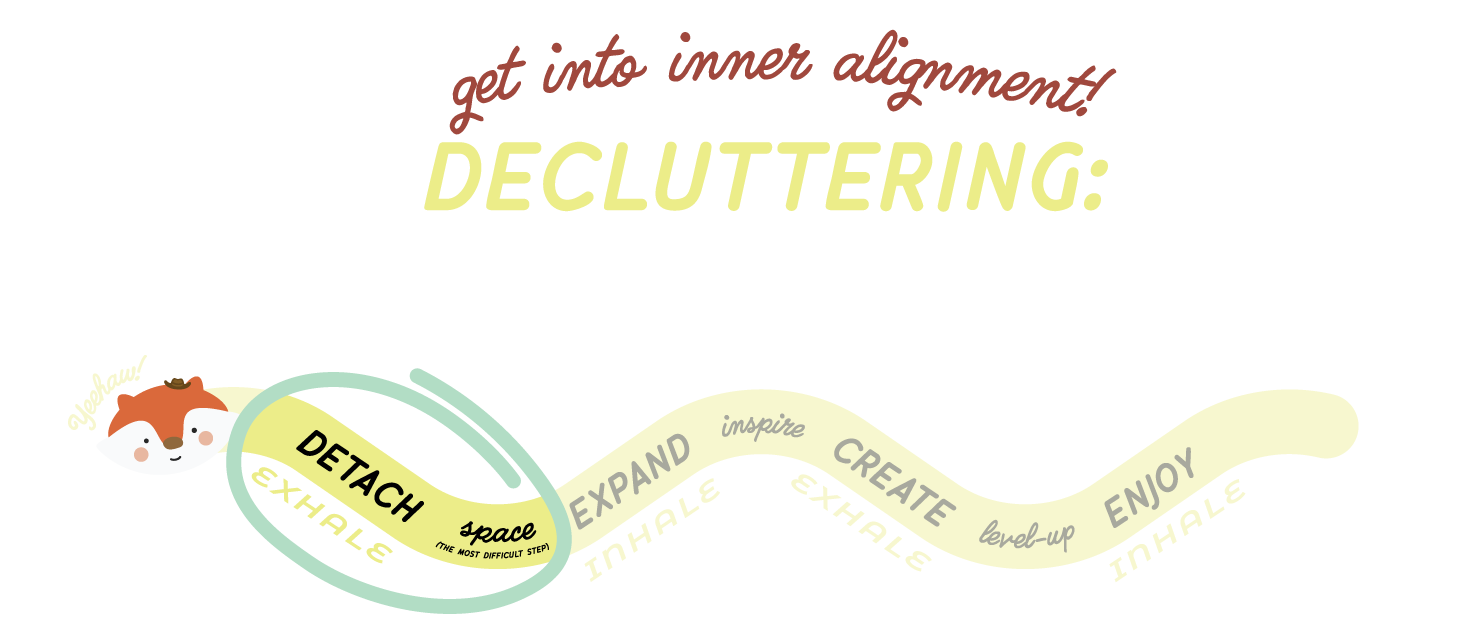
Everything starts in the mind first (internal), then goes out to the ‘3D’ (external). Get aligned by deciding which of your physical possessions is coming with you into your new life!
Think of it like – every day you have 100 Energy Dollars. If you own a lot of stuff, you are spending 75 Energy Dollars just on maintaining your household. Let’s free you up so you can spend those Dollarydoos elsewhere!
A lot of anxiety, stress, and ADHD-like symptoms start melting away once the decluttering process begins. Let’s get started decluttering and organizing!
Believe it or not, accumulating clutter is mostly mental and emotional (your internal state will dictate your external state). You’ll learn how to identify emotional attachments to physical items and how to move through the emotions easier.
❋ Easy Steps to Get Started
#1 cheerleader here... Or colorguard flag girl. I’ve been one of them, guess which one haha. You’re in charge here, I am just helping guide you along. We’ll work together to make sure you absolutely love everything you decide to keep!
❋ Collaborative Energy
Your nervous system is our guiding star. You will count how many things you own and when your nervous system starts getting ‘activated’ AKA stressed, we will base your individualized decluttering method around your unique ‘capacity’ number.
❋ Numbers Method
Think of every item you own and unfinished project you have like an open browser tab running in the back of your brain.
How many tabs are open?
PRO TIP - COUNT YOUR STUFF!
Step 1 - Numbers Don’t Lie
Count Everything You Own
The BEST state to start decluttering is when you have finally said enough is enough and uttered the words “I want to burn my house down and start my life over.”
It is a state of decision fatigue — but really, it’s more like ragefully-contemplating-arson-but-won’t decision-fatigue.
Yes, I actually want you to hate how you live. It will make things way easier. AND you will feel SO MANY good feelings when we’re deep in this process and you start loving the changes in your home, head, and heart!
Hate is a good emotion to have here - it’s actually rooted in fear, and it says ‘there’s something here I have to explore internally.” We do the deconstruction work around it that includes decluttering and changing behaviors to get you back into your most creative self!
You couldn’t have known this at any other time in your life, so don’t think you wasted any time. Think of this as R&D! You are actually right on time :)
Count the # of items you own – you will have 2 numbers
Example:
#1 - Capacity: 4,800 items
The number that you say 'holy crap I have so much stuff' – this is your 'capacity’.
#2 - Total: 15,383 items
The total number of items you own. Ballpark if you need to.
We will use #1 Capacity to shape how many items you keep. In this scenario, you will end up donating, gifting, selling, or tossing 10,000+ items! Don’t you feel better already?? :)
Most people could function pretty well owning 2,000 objects or less (what those are, are up to you!)
Unless you’re adding on an additional family member, you likely don’t need ‘more space’… you just need less stuff.
AN OBSERVATION:
Write your top 10 priorities in life
Step 2 - Redefine What Matters
You are always becoming a new person. Who you are today is not who you were a year ago, and definitely isn’t who you were 10 years ago. Your hobbies, social circles, career goals, and life goals have likely changed a few times. Let’s get current!
• What do you want to focus on in the next 6 months?
• How do you want to feel while doing those things?
• What relationships do you want to develop or deepen? (Can be relationship to self)
• What experiences do you want to have?
• What emotional states would you prefer to be in?
Don’t write things like ‘I want to feel less stressed’ - this is actually from a state of lack - instead write something like ‘I want to feel free, calm, relaxed, abundant’
Now, let’s play with some fun manifestation techniques while we’re at it. Write your list as if you already accomplished it.
• I’ve always felt free, calm, relaxed, abundant
• I already made my career switch
• I already cultivated a deep and loving relationship with myself
• I already traveled to South America
Did you feel the shift? You’re getting into alignment. Those experiences are already on their way to you :)
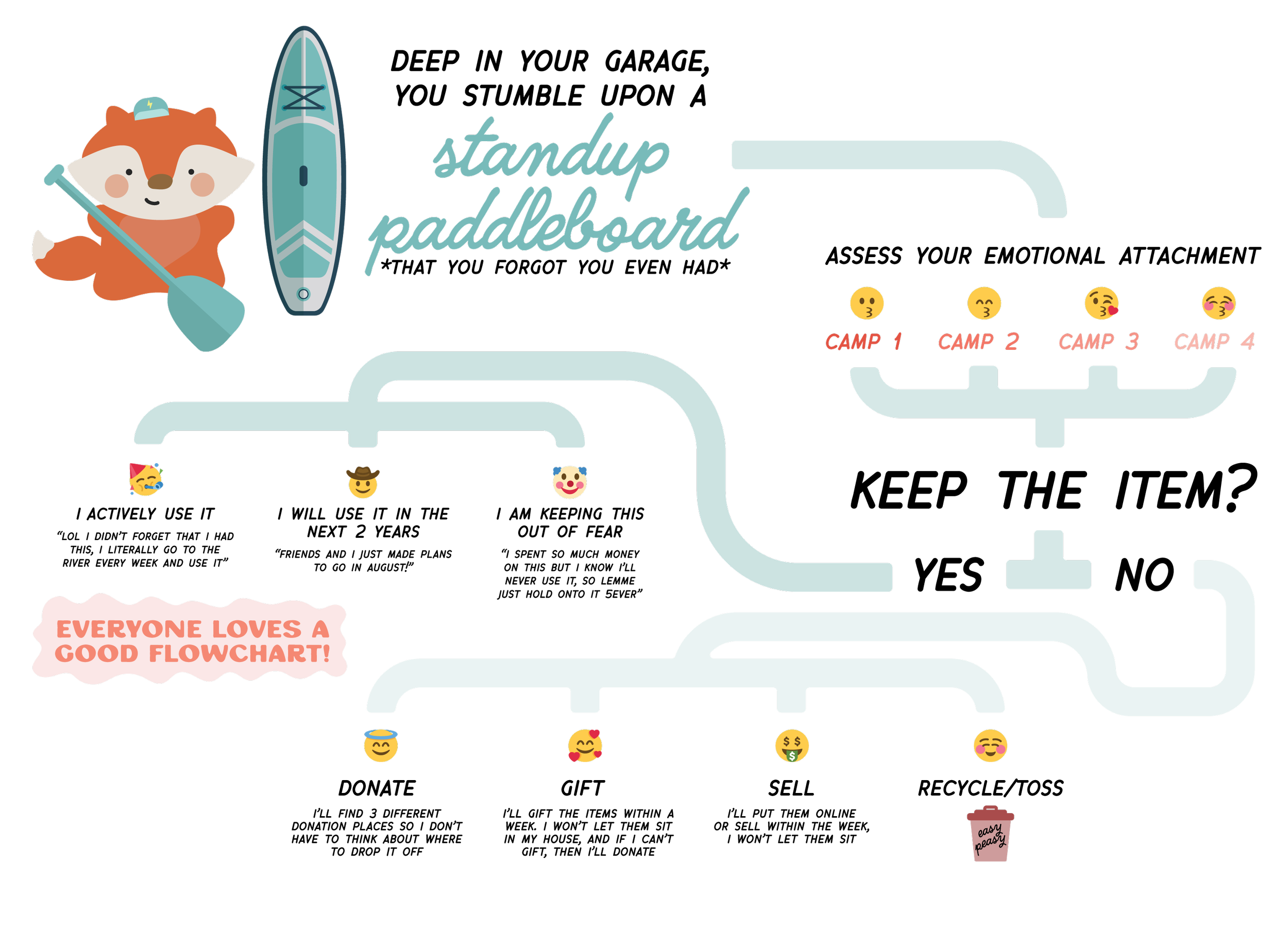
ASK YOURSELF:
Have you used it in the last 2 years, will you use in the next 2 years?
Are you actively using it?
Be honest. It’s okay to let things go even if you paid a lot of money for it! That is the price of your peace of mind.
Step 3 - Understanding Emotional Attachments
Gather all of your pens and get rid of the ones that don’t work
Hold an object in your hand, what camp are you in? There is no wrong answer! We will figure out which items are easier to declutter for you.
Camp 1 - No emotional attachment whatsoever (probably 10-15% of your possessions)
Camp 2 - Some emotional attachment (probably 50% of your possessions)
Camp 3 - Definite emotional attachment (probably 20-30% of your possessions)
Camp 4 - I would risk my life to save this thing (probably less than 5% of your possessions)
We want to figure out what is ABSOLUTELY staying (do not fight your emotional flow). And then work on Camp 1 & 2. You can likely prune away 10% of your stuff today if you just try to get rid of absolute junk.
Remember: You only have so much emotional bandwidth (every person varies). The more time/energy you spend buying/maintaining/cleaning your Camp 1 & 2 physical possessions, the less you will be able to care about your own well-being, friendships, family, career, experiences, and so on.
Ditch the outdated hobbies, unread books, old identities, and this-will-never-be-finished projects that are needlessly taking space in your house & head and you will get a ton of energy back.
Unburden yourself!
If you haven’t read that book you bought 10 years ago, you probably aren’t going to. You can always buy that book again if in 3 years you get an inkling (but likelihood you will forget it ever existed). It’s okay to try something and not have followed through to completion – consider it a rough draft.
RADICAL HONESTY:
Step 4 - Changing Your Shopping Habits
1 item in; 3 items out
For the first few months of the decluttering and organizing process, your shopping behavior isn’t going to change much – and that’s perfectly fine! It can be tricky to change shopping habits (AKA consumer behavior) quickly because it is rooted in several different dimensions: economy, stock markets, desire for friends to do well, fun trends, you don’t know what to do with extra money (spoiler alert: invest it, find new experiences, take new classes, travel).
SO! We can mitigate the clutter by implementing a rule at the END of your shopping behavior, which is — for every 1 new item you bring home, 3 old items have to leave.
Try it the next time you go shopping, you can increase that number of items-out if you want - maybe you up it to 5 or 10 items if you’re feeling spicy :)
Go shopping >
Bring home 10 new items >
Declutter 30 old items immediately >
Rinse & repeat until you’ve decluttered to your ‘capacity’ number
Think about what you currently own like stocking a refrigerator. Are you realistically eating everything in there? No!
If items like lightbulbs, paperclips, and power tools started smelling bad after 2 years of sitting in your drawers, you’d probably throw away 70% of everything you own today.
CALORIES IN; CALORIES OUT
Declutter in chunks & categories
Step 5 - Slow & steady
Don't try to tackle everything today. You didn't accumulate 50,000 things in a day, you're not gonna get rid of everything in a day.
Work in 2-hour chunks, a few days apart (you are making calculated, one-off decisions, using up a good amount of those 35,000 daily decisions)
Make a pass where you are only throwing things away. If you have 50,000 items, aim to donate/gift/toss 500 items or 1% (or make your own number, based on how much stuff you own).
SWEEP 1: Absolute Junk (2 hours)
Try to gather all your stationary items (pens, paper, notebooks) in one pile. Throw away the pens that don't work. Throw away the paper that is unusable. Go through your notebooks and either chuck 'em, or rip out the pages already written on them and throw them out. Do not buy any more notebooks until these are all used up!
Old Socks & Undies (1 hour)
You can get rid of some things. Just toss 'em.
SWEEP 2: Stationary Items (1 hour)
Gather everything that doesn't have lids. Wash em, or post these on your local Buy Nothing group. People sometimes use empty to-go containers for planting seeds. Do not overthink this, and do not start imagining becoming a homesteader (at least not yet). Just get rid of the tupperware lol.
Hats, Beanies & Scarves (1 hour)
Collect all of these you own. Get rid of 50% of them. (Donate, post on Freecycle/Buy Nothing, etc!)
SWEEP 3: Tupperware (1 hour)
Step 6 - Enter Into Empty Space
Rest Up!
Think of Space like the void or the in-between of your former self and your new self. It can feel daunting, eerie, unsettling, scary – and it can also feel peaceful, calm, tranquil, and relieving.
Rest is recalibration. Stop decluttering for a few days to allow your nervous system to sit in the empty space. Your decision-making reservoirs need to build back up and you need fresh eyes to look at your possessions from a different perspective (or frequency). Give yourself a few days in between each 2-hour decluttering session and chill!
CHALLENGE: If you need something, try to use what you already have.
PRO TIP - NAVIGATING THE VOID
Sit in the empty space. Feel the emotions that start surfacing. Is it a desire to go out and shop? (Remember 1 item in, 3 items out) Is it fear? Is it peace and relief? Ask yourself what that underlying fear is – it will likely unlock a deeper layer of life you can now go explore.
Prioritize gaining experiences, leveling-up in skills, and building community, not material possession accumulation!
If you want to treat yourself while in the decluttering process (highly recommend), go get a little hot choco or fancy croissant from your local cafe & bakery. Or a massage, sports game, hike, dinner with a friend, etc.
Step 7 - The Law of Relativity
Gratitude & Abundance
Buddhist Monks tend to have almost nothing in their possession, yet they are some of the happiest people on earth!
Remember: Most people could function on owning around 2,000 items. Not that you have to, but even 1,000 items is quite a lot of stuff if you think about how many hands you have and how many hobbies you could have throughout the week.
It's all relative - and your imagination matters more than you think. Don’t just buy stuff because the commercials told you to!
• You don't need a 20-step skincare routine (this is actually probably doing some damage to your skin)
• You don’t need 5 cars (unless you own a business)
• You don’t need 15 pairs of jeans (unless you’re a rancher)
You can want them all of those items –that’s perfectly great – your nervous system, however, will dictate whether or not you SHOULD have those. Does looking at the stuff you own stress you out?
Being honest with yourself, paring down, and being content with what you own is one of the most relieving things you can do. You won’t have to work as hard to upkeep your items. It doesn’t mean that you have to live like Buddhist Monks or only buy cheap items. You can have luxurious items… just a smaller amount that you really enjoy and love. You will cultivate even better taste moving forward with patience and a very intentional eye. Don’t sacrifice comfort and vibes in this process!
THE FINAL TA-DA! – THE NEW YOU
You’re going to form into a new person. Certain anxieties and stressors will go away, you will start completing backlogged to-do items, you will start having more energy, you will start being more present with friends and family, you will start exercising more, you will gain clarity, material boundaries, and a new sense of self.
Remember: If you are stressed out, your imagination & creativity don’t work as well
As you keep up the decluttering process indefinitely, your nervous system will start relaxing and you will become way more creative than you ever have been before in your life!
Step 8 - Moving Forward
Conscious Consumption
Moving forward, ask yourself why are you buying the item? Is it because you're stressed, you want it? Is it because it’s a genuine need? There is no right or wrong answer, and don’t overthink it too much – just understand why. Is it generational poverty creeping in? Or a hankering for something sweet.
I generally run my purchases through 4 filters:
• I need this item for X reason
• I want this item for Y reason
• I am okay with letting it go after its intended use
• I am okay with putting the energy in to maintain & clean it
Otherwise, I leave it be. Sometimes I get impulsive, especially when it comes to art projects or chocolate cake, but in general my 1 item in, 3 items out policy mitigates any sense of accumulation. It only takes me about 10 minutes to clean every day, and once a month I’ll spend an hour cleaning.
For more tips & tricks, you can check out Buy it for Life trends, Minimalism, Decluttering, the Zero Waste Movement, Buy Nothing/Freecycle groups and more. Enjoy the peace of mind!
New Behaviors:
• Keeping a capacity # in mind when owning objects (no more than 2,000 should do the trick)
• 1 item in, 3 items out until nervous system is satisfied
• Donating & gifting within a week
• Doing a 2-hour decluttering sweep once per week
• Appreciating something at the store that is cute or exciting, and not purchasing it
• Sitting in the empty space without being urged to fill it
• Using libraries, public parks, public museums, nonprofits, community events, communal kitchens, thrift stores, and Buy Nothing groups to find items (or give them away!)
• Getting creative with what you already own
• Seeking more experiences, travel, classes, volunteering opportunities and community building, woohoo!